


ServiceXRG
  • Your Challenges
    • Overview
    • Strategic Support Assessment
  • Our Solution
    • Overview
    • Achieve Strategic Support
    • Our Process
    • Strategic Support Framework
    • Membership
  • Why ServiceXRG
    • Overview
    • Capabilities
    • Clients
    • Team
  • Resources
    • Resource Library
    • Blog
    • Support Leadership, Unfiltered
  • Member Login
ServiceXRG
  • Member Login
  • Strategic Support Assessment
  • Let’s Talk
  • Your Challenges
    • Overview
    • Strategic Support Assessment
  • Our Solution
    • Overview
    • Achieve Strategic Support
    • Our Process
    • Strategic Support Framework
    • Membership
  • Why ServiceXRG
    • Overview
    • Capabilities
    • Clients
    • Team
  • Resources
    • Resource Library
    • Blog
    • Support Leadership, Unfiltered

Blog : What is the primary expected outcome of your service organization?

  • Previous Post
  • All Posts
  • Next Post

What is the primary expected outcome of your service organization?

By Tom Sweeny March 15, 2024

Service teams are shifting their focus to the attainment of strategic outcomes.  It is no longer enough to close cases, clear backlog or even settle for satisfied customers.  Strategic service outcomes are defined by rates of adoption, time to value and ultimately revenue retention and growth.

We asked service leaders with responsibility for both Support and Success functions to identify what they consider to be the primary expected outcome from their service teams.  Our findings and analysis are below.
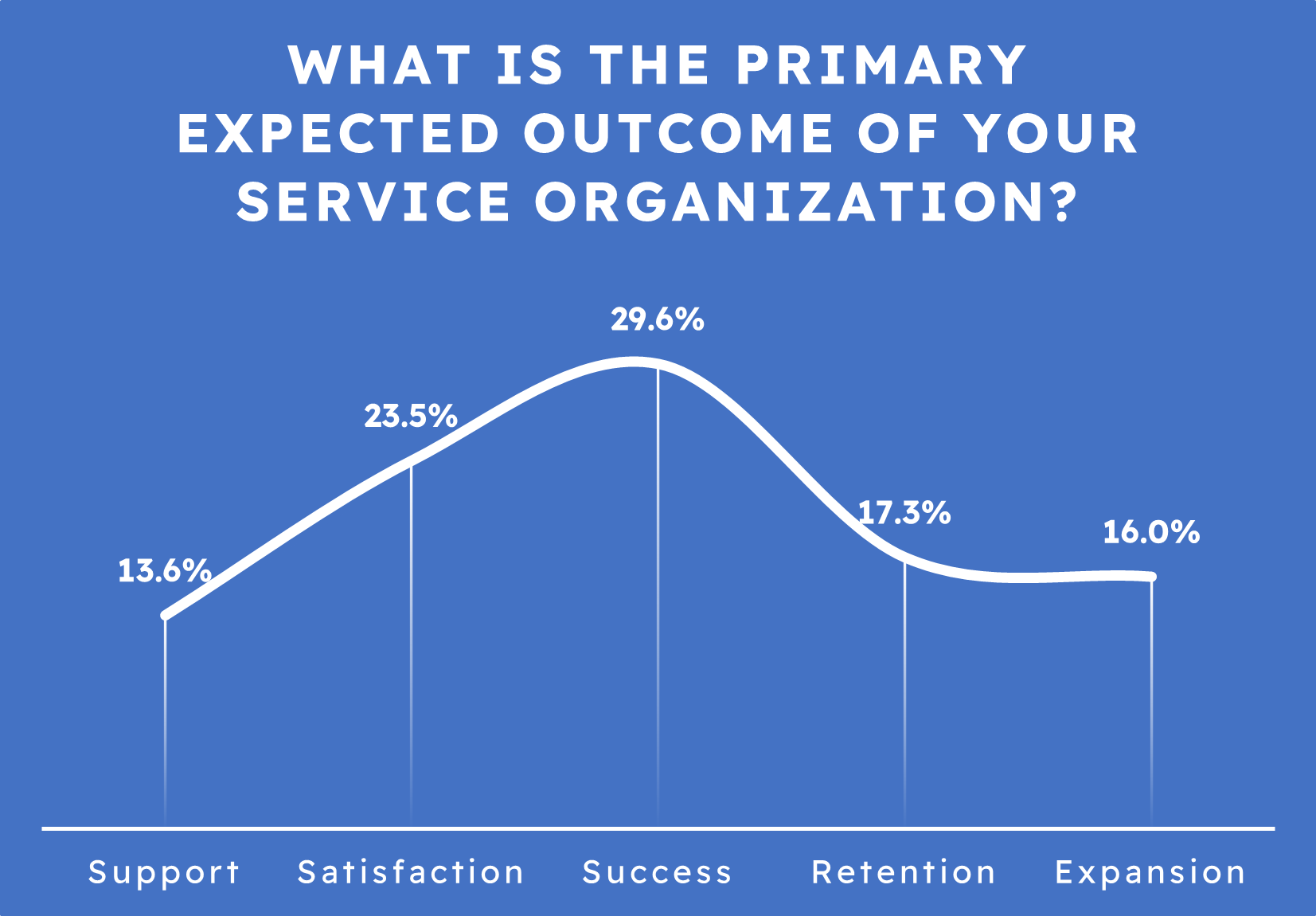
We asked: What is the primary expected outcome of your service organization?

Here are the choices we offered:

  • Support, answer customer questions when they need help.
  • Satisfaction, provide service experiences to satisfy customers.
  • Success, help customers adopt and successfully apply products.
  • Retention, use services to retain existing relationships.
  • Expansion, create opportunities to expand relationship value.

The Primary Service Outcome

We realize that many service teams may have multiple functions and desired outcomes, however, we wanted service leaders to choose one – their primary outcome.

While there is no right or wrong answer, these responses indicate the primary focus of service teams today.  Some are focused on break-fix support, others are content to drive CSat scores.

Resolving issues and satisfying customers is an important step in servicing customers, but it should not the ultimate objective of a service team.

Aspire to Do More

We observe that most companies look beyond issues resolution and satisfaction and aspire to drive adoption of products and to help customers be successful.

Adoption and success are great ways to help customers realize value, but is that even enough?

For the majority of service leaders, they indicate that their primary outcome is focused on retaining and/or expanding the value of existing relationships.

Service is a key enabler of retention and growth.

As you consider your objectives for Support and Customer Success consider your primary expected outcome. Don’t settle for anything less than contributing to the retention of customer relationships with the aspiration of creating opportunities for growth.


Build Strategic Support Capabilities That Drive Business Outcomes

The ServiceXRG Framework for Strategic Support defines the core capabilities leading organizations use to scale efficiently, prevent issues, and prove support’s measurable contribution to customer and business success.

Strategic Support Framework
  • Previous Post
  • All Posts
  • Next Post

Subscribe for even more resources and the latest in your inbox.

"*" indicates required fields

This field is for validation purposes and should be left unchanged.
Name*

By clicking the "Submit" button you accept and agree to be bound by the Terms of Use and Privacy Policy.

Related Posts

  • 5.13.26 Read Time: 2 Mins

    What to Measure Instead of Deflection: The Engagement Framework

    Stop measuring defection and start measuring engagement – here is how.

  • 5.5.26 Read Time: 4 Mins

    The Hidden Risk in Measuring Deflection: Why AI Makes It More Dangerous

    For decades, support organizations have measured deflection as a success metric. High deflection rates meant customers were finding answers on their own. Self-service was working. Support was becoming more efficient. …

  • 4.28.26 Read Time: 4 Mins

    Stop Measuring Deflection

    Stop measuring Deflection and start measuring Engagement.

ServiceXRG

© Service Excellence Research Group, LLC 2026. All Rights Reserved.

Website by Imagebox

Contact Info
  • Email: info@servicexrg.com
  • Phone: 800-475-0089
Social Media
  • LinkedIn
  • Newsletter
  • Twitter